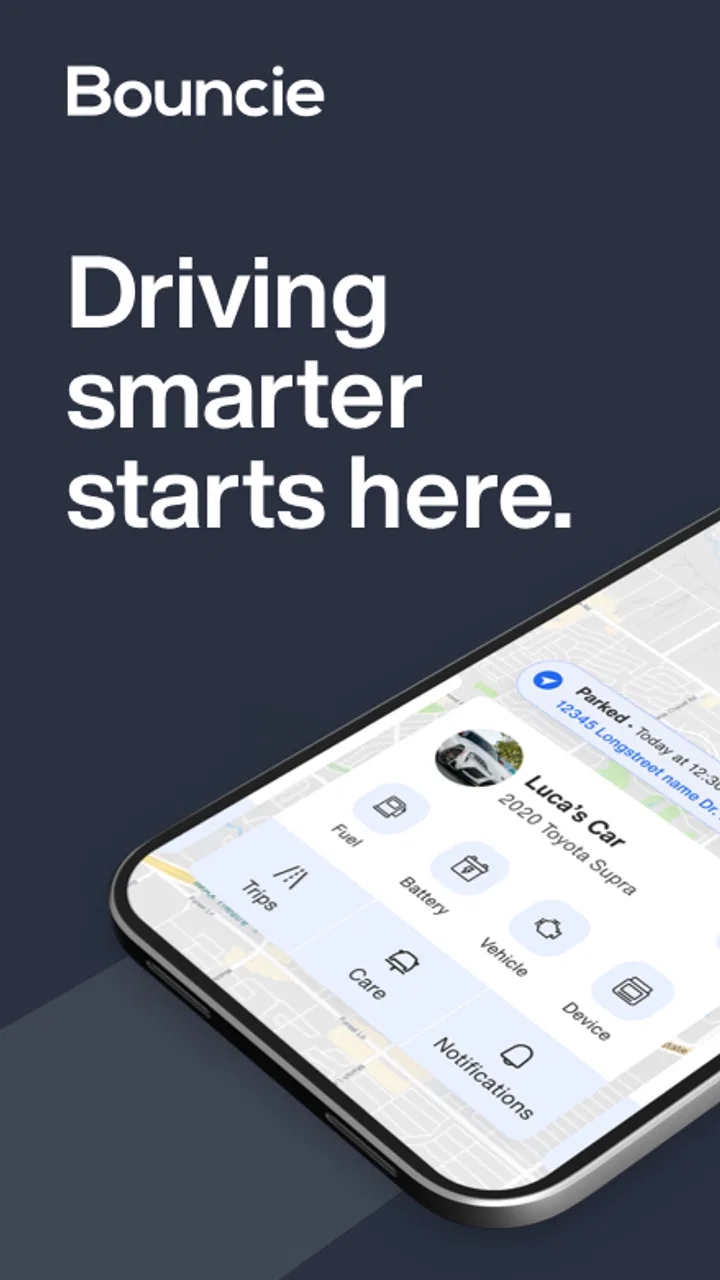
Bouncie
- 4.2
- Rating
- 100.00K
- Installs
- Free
- Price

 Analysis by App-foxy
Bouncie is the kind of driving app I would recommend to someone who wants a clearer picture of what is happening with a vehicle without turning every trip into a technical project. It sits in the Auto & Vehicles category, is free to install, and comes from Tail Light, LLC. I found its appeal less in flashy presentation and more in the way a connected-car tool can make everyday driving easier to understand.
That usefulness depends heavily on the setup. A connected driving service is only as helpful as the link between the vehicle, the hardware involved, the phone, and the account. When everything is working, the app can become a quiet background tool for checking on trips and vehicle activity. When something goes wrong, users may initially blame the app even though the problem is elsewhere. My experience with this type of workflow is that knowing where to look first saves more time than repeatedly closing and reopening the screen.
Where the experience usually gets stuck
The first point of friction is expectation. Bouncie is not simply a conventional map app that works from the phone alone. Its purpose is connected driving, so the useful information depends on the vehicle-side connection as well as the mobile application. If a user expects immediate results without completing the setup around the car, the first impression can be disappointing.
You May Also Like

 Google Keep - Notes and lists
Google Keep’s Quiet Growth Shows the Appeal of Simpler Notes
As mobile work gets busier, Google Keep keeps winning a simple contest: capture a thought quickly, find it later, and get on with the day.

 Blood Strike: 2.5 Anniversary
Blood Strike’s Loadouts Turn Every Drop Into a Tactical Gamble
A close look at Blood Strike’s custom loadouts: how fast access to signature weapons reshapes its battle royale rhythm, rewards preparation, and narrows the gap between fights.

 Pandora - Music & Podcasts
Pandora’s Music Is Easy to Start, but Harder to Recover
Pandora’s strength is its low-effort path from a seed to a station. Its weak spot is how much confidence it asks you to place in connection, setup, and quiet recovery.

 8 Ball Pool
 Is Built on Rivalries, Rematches, and Routine
A close look at the rivalries, rematches, shared routines, and unanswered safety questions that turn a quick pool match into a persistent mobile community.

 Samsung Music
’s Quiet Strength Is Playing What You Already Own
Its reach comes less from spectacle than from dependable access to a personal library. That simplicity is both the app’s strongest retention engine and its ceiling.

 AccuWeather: Weather Radar
AccuWeather Review: A Quick, Clear Forecast for Everyday Decisions
For everyday plans, the best forecast is the one you can understand quickly. AccuWeather makes rain timing, radar, and local conditions easy to act on, with a few trade-offs.
More From Our News Desk



I would begin by treating the app as one part of a chain. The phone needs to be signed into the intended account, the vehicle connection needs to be in place, and the car has to be in a state where that connection can operate. A blank, delayed, or incomplete view does not automatically mean the application itself is broken. It may indicate that one link in the chain has not finished registering.
Another common sticking point is confusing a delayed update with a failed trip. Connected services may need time to receive and process information. If I were checking a recent journey, I would avoid making several changes at once. Instead, I would note what is visible, wait briefly, and then check again. That simple habit makes it easier to distinguish a temporary delay from a genuine setup problem.
The app’s public reception suggests that many people find the concept useful: it holds an average rating of 4.1 from around 1,700 ratings, with roughly 650 written reviews. I would read that as a sign of a practical product with a generally positive experience, rather than as a guarantee that every vehicle or phone combination will behave identically.
What I would check before assuming the app failed
I would first confirm that I am using the same account associated with the vehicle connection. Account mix-ups are especially easy when more than one family member uses the car or when a person has separate personal and shared email accounts. A successful sign-in is not always proof that it is the correct sign-in.
Next, I would check the physical side without repeatedly disturbing it. If the connected vehicle device is loose or not seated properly, the app cannot compensate through software. I would also make sure the vehicle itself has been used normally after installation, since a connection may not show meaningful activity while the car has not been driven.
On the phone, I would check the basics: a working internet connection, enough battery for normal background operation, and the current application build. Bouncie’s current version is 4.23.4, and it supports Android 7.0 or later. Those details matter when a phone is older or has been running a heavily restricted software environment.
I would also avoid changing several phone settings blindly. Battery-saving tools, background limits, and network restrictions can affect how promptly a connected app refreshes. The safest approach is to review settings only when there is a specific symptom, such as updates appearing only after manually opening the app. Randomly granting or removing access can make diagnosis harder.
A setup routine that prevents avoidable confusion
My preferred setup routine is deliberately boring. I would install the app, sign in carefully, follow the vehicle connection instructions, and then allow the system a normal opportunity to establish communication. I would keep the phone connected to a reliable network during the first checks and avoid judging the service from a single moment immediately after installation.
Once the vehicle has been driven, I would compare what I see in the app with what I know actually happened. A short, familiar trip is better for this than a complicated journey involving several stops. That gives me a clean reference point and makes it easier to notice whether the issue is with timing, account selection, or the vehicle connection.
One useful habit is to record the order of events. I would note when the vehicle was used, when I opened the app, and when the information appeared. This is more useful than simply saying that the app is “not working,” because a consistent delay points toward a different problem than a total absence of activity.
I would also decide in advance who needs access. If a household shares one vehicle, agreeing on the primary account and the people who should use it avoids duplicated setup attempts. Reinstalling the app on several phones can create confusion if nobody knows which account is meant to be the source of truth.
Recovering the workflow when updates look wrong
When the app does not immediately reflect a drive, I would use a gradual recovery process rather than jumping straight to deleting everything. First, I would confirm that the trip actually took place after the vehicle connection was installed and that the phone is online. Then I would close and reopen the app once, sign out only if the account appears wrong, and check again after a normal interval.
This order matters because aggressive troubleshooting can erase useful clues. If I uninstall the app, change accounts, and alter phone settings at the same time, I may fix the problem without learning what caused it. A measured sequence gives me a better chance of repeating the solution later.
If information appears partially, I would look for patterns. Does it happen only after the vehicle has been parked for a long time? Does it happen on one phone but not another? Does it affect one journey or every journey? Those distinctions are practical. A single late update is different from a connection that never reports activity.
For a family vehicle, I would also avoid using several phones to test the same issue simultaneously. One person should perform the checks and write down the result. This reduces the chance that different sessions, accounts, or network conditions make the behavior look inconsistent.
A realistic everyday example
Imagine a parent lends the car to a teenager for an afternoon. The parent opens Bouncie and does not immediately see the expected activity. My first move would not be to assume that the trip vanished. I would confirm that the teenager used the intended vehicle, check that the account is the household account, and wait long enough to separate a reporting delay from a failure.
If the information later appears, the lesson is about timing rather than a broken installation. If nothing appears, I would compare the result with a short test drive by the regular driver. That test can reveal whether the issue follows the vehicle or the original user’s phone and account. It is a much cleaner diagnostic than repeatedly refreshing during a busy afternoon.
This is also where expectations should stay realistic. Bouncie can be useful for visibility, but I would not treat any connected driving app as a substitute for attentive communication, safe driving habits, or emergency response. The app belongs in the category of helpful vehicle information, not as permission to monitor a driver constantly or make urgent decisions from a delayed screen.
When the app may not be the cause
Some problems sit outside the application. A vehicle-side connection can be affected by installation, power, or the car’s own condition. A phone can have network trouble, background restrictions, or an operating system that is no longer a good fit. An account can be correct in one place and wrong in another. In each case, reinstalling Bouncie alone may accomplish very little.
I would be especially cautious about blaming the app when other online services are also slow on the same phone. That points toward connectivity rather than a single application. Likewise, if the issue follows the vehicle across different phones, I would focus on the vehicle-side setup before spending time changing mobile settings.
Older devices deserve a realistic assessment. The minimum Android requirement is version 7.0, but meeting a minimum does not necessarily mean that the overall experience will feel modern on every handset. Limited storage, an aging battery, or aggressive manufacturer power management can create friction even when installation is technically possible.
There is also a privacy and trust question that I would discuss with other drivers before using a connected vehicle service. Everyone who drives the car should understand what the service is intended to do and who can view the resulting information. That conversation is not a software fix, but it is part of responsible setup, particularly in a shared household.
Who will get the most from it
I see Bouncie as a good fit for people who want a simple connected view of vehicle activity and are willing to complete a careful setup. It can make sense for a household sharing a car, a person managing more than one regular driver, or an owner who prefers having driving information organized in one place instead of relying on memory.
It is less suitable for someone who wants a phone-only navigation tool, a detailed mechanical diagnostic platform, or an instant answer to every vehicle question. Those needs point toward different categories of products. A navigation app is better for turn-by-turn route planning, while a dedicated diagnostic reader is more appropriate when the main goal is examining vehicle fault information. Bouncie’s value is in connected driving visibility, not in replacing every automotive tool.
I would also skip it if I am unwilling to deal with an installation check or occasional troubleshooting. Connected convenience always brings a little dependency on hardware, account setup, communication, and phone compatibility. Someone seeking a completely passive experience may prefer a simpler manual log or a basic navigation application, even if those alternatives provide less connected information.
How it compares with ordinary alternatives
The usual alternative is to rely on the car’s dashboard, a phone’s map history, and personal notes. That approach can be enough for an individual driver who only needs directions or a rough memory of where they went. It is also less dependent on a separate vehicle connection, which can make it feel simpler.
The trade-off is organization and shared visibility. A phone map app is primarily designed around the phone user’s navigation, not around a connected vehicle workflow. A handwritten note can be accurate, but only if someone remembers to make it. Bouncie is more appealing when the goal is to bring vehicle-related activity into a dedicated service rather than reconstructing it later from several unrelated sources.
On the other hand, a dedicated automotive diagnostic product may offer deeper technical information for a mechanically minded owner. If I am trying to investigate engine codes or perform hands-on maintenance, I would choose that kind of tool instead. Bouncie is the better choice when I value an accessible driving overview more than workshop-level detail.
What I would do before contacting support
Before asking for help, I would prepare a concise description: the phone model and operating system, the account being used, whether the vehicle connection was recently installed, whether any activity appears at all, and whether the issue affects one phone or several. I would include the timing of a test drive rather than a vague statement that the service stopped working.
I would also avoid sharing unnecessary personal information in screenshots or messages. A useful troubleshooting report should explain the behavior without exposing unrelated account details. This makes the conversation clearer and keeps the focus on reproducing the problem.
Because Bouncie is free, the barrier to trying it is low, but free does not mean frictionless. I would give myself enough time for a proper test instead of deciding after the first incomplete screen. The service has passed the threshold of 50,000 installs and carries an Everyone content rating, which makes it approachable for a broad audience, but individual results still depend on the vehicle and phone environment.
My practical verdict
After looking at the complete workflow, I think Bouncie is worth trying for drivers who want connected vehicle information without starting with a complicated automotive toolkit. Its strongest quality is practical focus: when the setup is correct, it can give a household a more consistent way to understand vehicle activity than scattered phone history or memory.
The main caution is that the app is not an isolated piece of software. If the vehicle connection, account, phone, network, or background behavior is out of step, the experience can feel unreliable even when the application is functioning normally. I would approach installation as a small system rather than a one-tap download, and I would use a short test drive to verify the result.
Tail Light, LLC has kept the product in the Auto & Vehicles space where it belongs, and the current Android release works with devices running Android 7.0 or newer. Since it is free and rated for Everyone, it is easy to evaluate without a financial commitment. My recommendation is strongest for shared-car households and drivers who value organized connected information.
The key decision is whether you want connected vehicle visibility badly enough to accept a little setup discipline. If the answer is yes, Bouncie is a sensible app to test. If you only need navigation, occasional trip directions, or deep mechanical diagnostics, a more specialized alternative will probably serve you better. For the right user, though, its everyday usefulness comes from making vehicle activity easier to follow without demanding constant attention.
FAQs for Bouncie
01What is Bouncie and how does it work?
Bouncie is a vehicle tracking app designed to provide real-time location updates, driving data, and safety alerts for cars. By connecting to your car’s OBD-II port, it collects data on trips, speed, fuel usage, and more. The app allows you to monitor and manage these insights through a user-friendly interface.
02Is Bouncie compatible with my vehicle?
Bouncie is compatible with most vehicles manufactured after 1996, which typically have an OBD-II port. It’s important to check if your specific car model is supported. Users can refer to the compatibility list on Bouncie’s website or consult their vehicle’s manual to ensure compatibility before purchasing.
03What features does Bouncie offer for vehicle safety?
Bouncie offers several safety features, including real-time location tracking, accident notifications, and emergency contact alerts. It also provides driving behavior analysis, such as reports on harsh braking or rapid acceleration, helping users stay informed about their driving habits and make improvements for safer travel.
04How does Bouncie handle data privacy and security?
Bouncie prioritizes user privacy and data security by employing encryption and secure data storage practices. User data is only accessible through secure logins, ensuring that sensitive information like location and driving habits remains protected. Users can review Bouncie’s privacy policy for more detailed information on data handling.
05What is the cost of using Bouncie, and are there subscription fees?
Bouncie requires an initial purchase of the device, and users must subscribe to a monthly service plan to access its features. The subscription fee covers data usage for tracking and reporting. Pricing details can be found on Bouncie’s website, allowing users to choose a plan that fits their budget.
Pros
- Easy-to-use interface for beginners.
- Real-time vehicle tracking feature.
- Customizable alerts for safety.
- Affordable pricing for features offered.
- Supports multiple vehicles on one account.
Cons
- Limited integration with other apps.
- Occasional connectivity issues.
- Setup may be complex for non-tech users.
- Requires subscription for full features.
- No offline tracking capability.

Bouncie
Gallery